
Black Parade

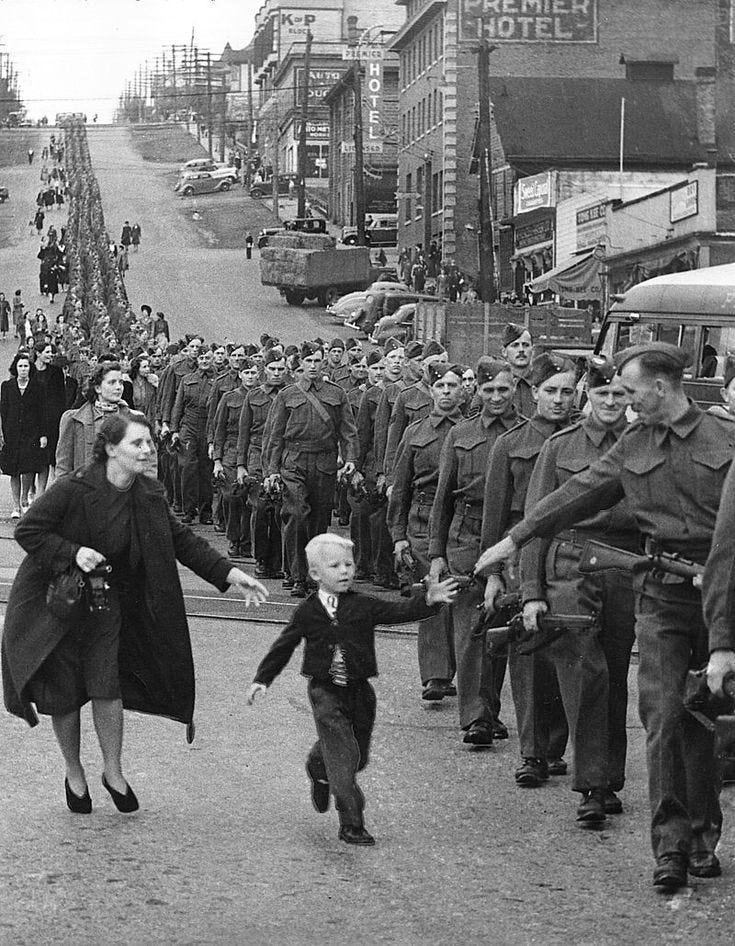
Soldiers’ lips pressed against trumpets. War war war cascaded across screen, radio and paper. Knees fell on pavements, fists flew to the heavens raining down the chant, “for King, for country!” Men with more than their lives to lose took what little they had and cowered in cellars where they’d drink and think until the bombs stopped falling — or until everyone was dead. Soldiers scoured streets in search of the likes of these.
“These men,” they said, “have no gratitude for all that the Fatherland has done for them.” Off in the trucks they went as their drinks were stuffed under the driver’s seat. “A little gift for the boys back at camp,” gap-toothed smiles sealed the deal.
In childhood, the stories were read, the movies were watched. In high school, sources were revealed, histories surveyed. “This will never happen again. Not in our lifetime,” promises were made.
“Don’t be makin’ no oaths, boy,” it was said.
“It’s justified. We need to do what’s right. We have to put a stop to their tyranny. It’s justified, isn’t it?”
But who would fight? Certainly not you. Definitely not me. Then who? Who?
“Leave that up to the Department of War and the letters they’ll post in the mail. Them letters’ll decide who gets to live and who gets to be a hero. An’ if you get to thinkin’ you’re too good for the front, then the MPs will get you just like they did with Jim and Joe and every other bastard that thought his house was more important than our home.”
Before work, fathers would stand out on their lawns or by doors waiting for the postman to pass by with his bag of promises.
“Hey Pat, got anything for me today?”
“For you, Leo and every other man on the block,” he’d answer as he handed him that envelope marked
DEPARTMENT OF WAR.
URGENT - TO BE OPENED BY ADDRESSEE ONLY.
Him, Leo and every other man on the block would do well to reserve pillow talk for a revelation — first to wives, then to children. But in moments such as these, dread whispers louder than the bells of reason. Thus, the envelopes are tucked away. Hidden in old jackets, up in the attic or between pages of religious texts that know no human touch.
“I heard,” comes the wife spinning webs, “that Mark got his summons. He’s off to the front…”
She’d ask but didn’t want to know.
“…”
He’d answer but didn’t want to say.
And the children were left to suffocate under the weight of promises made to break.
Only after they had gone to bed did the wife, before the bathroom mirror, call out to her husband and ask, “when do you think you’ll be getting yours?”
He could tell what she meant and he knew better than to lie any more than he already had.
He dropped it right by her hand.
She saw the words and said, “what does it say?” with a voice that pleaded with an unforgiving reality.
“…”
“What does it say?” she got to her feet and held him by his collar shoving his head this way and that as if to get an answer to fall out of his ears. And he, knowing that there was no petitioning reality, grabbed her by the waist and pulled her close for a hug that they had denied each other since husband and wife became mom and dad.
The morning after is lighter in all the homes. Mom knows that she’s no longer mom — once again she’s a wife who wants nothing more than to hold her man in place and never let him go. The kids, tasting love in the air, are more loquacious, spirited and willing to ask for a little extra cash for lunch. But dad knows that come next week that joy would be repossessed.
“Do you have to go?” the wife would ask her man that night.
“…”
What he felt without certainty… really, what most men (maybe even the absconding Jim and others just like him) felt was a gnawing curiosity.
He would never tell it to his wife and especially not his daughter. They wouldn’t understand. They’d hear him speak and see nothing more than a beast excited at the thought of blood and guts.
“Do you have to go?” his son asked him.
“I-I think I’ve gotta. Don’t got much of a say in the matter,” he responded.
“You’ve always got a say, don’t you?”
He looked right at his boy who spoke only as a child could — rationality free of rationalization.
“You’re right,” he paused and looked outside the window. “I guess… don’t tell your mom but I guess a part of me wants to go.”
“Why d’you wanna go? Mom says war’s bad and people get killed and… do you wanna get killed?”
Dad opened the window and leaned out feeling the cool city breeze beat against his shaved cheeks.
“Your mom’s right but…” he turned to his boy, “just want to see what I’m made of. I just want to know what it’d be like to have to… I’ve never had to fight for my life…”
His son’s eyes moved from him to the night sky. Maybe he understood. Maybe he didn’t. Dad wasn’t quite sure of it himself.
“Dad,” the boy called out.
“Yeah?”
“I got myself into a fight,” he rushed through the sentence then dropped his head low.
“Who won?”
“Hasn’t… It’ll be tomorrow… Dad, I’m kinda scared and I thought… I don’t know… I don’t wanna fight him. He’s bigger than me and…”
Dad got down on his knee and moved in for a hug. The boy’s arms fell by his sides before reaching as far round his father’s back as they could.
“Don’t” the sobs came, “think-I-can-do-it…”
“Well, you’ve always got a say, don’t you?” they both chuckled in each other’s embrace. “You know what,” dad was the first to release and look his boy in the eyes, “here you are about to fight for your life as I’m getting ready to fight for mine. Looks like we’re a perfect team.”
“I don’t want you to go, dad.”