
Primordial
The heart of an Inquisitor

These stories are more than just words on a page—they’re my passion, my craft, and my heart poured into every line.
What you’re about to read is completely free, but if you find yourself immersed, entertained, or moved, I’d truly appreciate your support. A simple cup of coffee goes a long way in helping me create more stories for you to enjoy.
If you’d like to show your appreciation, consider buying me a coffee. It’s a small gesture that makes a big difference.
Enjoy the story, and thank you for being here.
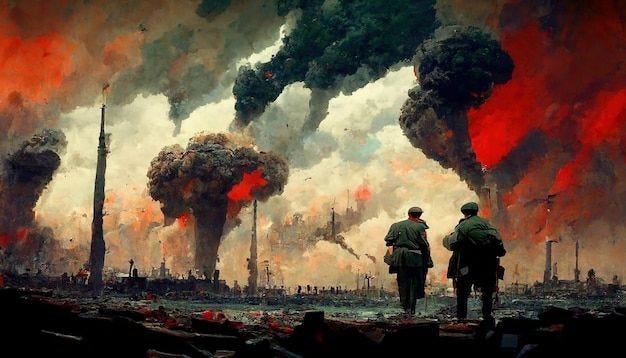
“Civilization is impotent,” he began as he played with an unlit cigar. “We shall pay for its design. Well, not you. Not me. But our children, as the good book says, will pay for the sins of their fathers.”
Despite being long retired, General McCay was intimately familiar with how decisions made in the capital influenced the direction of the war. He was no longer privy to classified information nor was he welcomed into war rooms. But he shared golf carts, club sandwiches and cigar lounges with the men whose whims changed the world. Of men such as General McCay, the masses said, “they live on different planes.”
“How will they pay?” Jack asked him.
Over his right eye was a matte black patch. A gift, he often jested, from his days in active duty. With his left eye — his only eye — he stared calculatingly at Jack.
“I would hope a journalist such as yourself is well-versed in history. Be that as it may, I will try to provide a trite, even generic, answer to your question: before the Romans, what is now called Germany was controlled by Celtic tribes. The Helvetii amongst others. Their time came and went.
Then came the Romans whose time, also, came and went. Then the Alemanni, the Franks and so on and so forth until we have what the young now champion as their progressive European government focusing on our carbon footprint and non-gendered bathrooms.
At each point of flux, each historical node, someone had to pay. For what, you might ask: Simply put — the weaknesses of their fathers. Pillage and plunder. Yes. Yes. The opposite of civilization is pillage and plunder. That is exactly what it is. Civilization is an attempt to reach for a perfect peace. A promise of eternal safety and security. Those who come and take… they are only concerned with pillage, with plunder.”
Jack pushed his glasses further up his nose revealing a crucifix tattooed on the side of his finger. McCay gave a coy smile.
“What, as a former general, is the conclusion of your analysis on this war?” Jack queried.
“I see you are a believer. Not many around anymore,” McCay pointed at his finger with the cigar.
Jack looked at the crucifix and said, “Catholic.”
McCay placed the cigar in an ashtray and reached for the top button of his shirt. He unbuttoned it and pulled out a golden rosary that had been pressed tightly against his chest.
“Have you prayed the Hail Mary today? Don’t get around to it much myself.”
“General, with all due respect, that isn’t why I’m here. I will repeat one more time: what is the conclusion of your analysis?”
The general chuckled before saying, “the greatest book I have ever read, besides the Bible of course, is titled When I Way No I Feel Guilty. Probably the one book that made me a general. Don’t know how old you are but by your skin, hairline and haste to get to a point, I can guess that I was around your age when I first read it. Want to know what I learned?”
“General…” Jack, stroking his hair, began before he was cut off.
“Want to know what I learned?” He picked up the cigar, brought it up to his eye and with a controlled tempo said, “Mr. Stone, want to know what I learned?”
Jack sighed and placed his pen next to the ashtray before saying, “what did you learn general?”
A huge laugh came from the general’s belly. His massive paw swallowed the cigar whole as he said, “sometimes the best response to confrontation is patronization.”
Jack leaned back into his seat.
“May we proceed, general?”
“Did you pray today?” the general repeated his question.
“No, general. No prayer for me today. Thank you.”
“And how is it you expect to conduct an effective interview without first consulting the good Lord?" He leaned forward and pointed at a chiffonier. “There is a lighter right there. Be a good sport and hand it to me.” A calmness settled behind his request.
Jack looked back at the chiffonier and noticed the lighter. For a moment, he paused
then got up for the lighter.
“Here you are,” he handed it to McCay.
“Thank you, Mr. Stone. Old age is a friend to no one.” He lit the cigar, took a puff and blew the smoke up into the ceiling. “I will answer all your questions without filibustering. But I do ask one favor of you.”
“What will that be, general?” Jack watched as the smoke settled in the room.
“I would like for you to pray for me — well, for my children, my grandchildren.”
The lighter was placed next to the ashtray. Jack’s eyes drooped towards it.
“What?! What do you mean?”
“You are a Christian man, like me. If so, you believe in the power and effectiveness of prayer, especially if more than one person commits to petitioning the Lord. So, Mr. Stone, I ask you to pray for my children and grandchildren.”
In his breast pocket, was a pack and a lighter. They were bought an hour before the interview was slated to begin. It was not yet open when he said, “would you mind if I smoke?”
McCay looked at him with a smirk and nodded his head.
Jack unwrapped the pack with a forced cadence.
“Thought I was gonna quit,” he said half-heartedly.
“Mr. Stone, I’ve quit smoking every single day since I was nineteen. The final hurdle to addiction,” he blew out another puff, “is death.”
Ease overcame Jack as he took in his first puff. All tension in the room was dampened under the smoke.
“Why do you want me to pray for your family?”
“You’ll be glad to know that the answer to that question ties in perfectly to the purpose of this interview. You see, Mr. Stone, I cannot say with any certainty whether we will win or lose this war.
Patterns, Mr. Stone. Patterns. I have been out on the front lines. Served behind the scenes. Watched as we went from men of numbers drawing up statistics showing our odds of success to young boys, much younger than yourself, crunching code into computers that tell us whether or not it would be beneficial to drop a bomb.
With all the technology at the tip of our fingers, we have forsaken humanity — and maybe for the best. Numbers, statistics, patterns — these are now our gods. These are not malevolent gods. A cursory look at the Old Testament might ascribe malevolence to a primordial Yahweh. No. No. The new gods, in their apathy, seek safety, security, civility… impotence.
Mr. Stone, I pray, and this is off the record, that we lose this war.”
Jack tapped the cigarette by the ashtray. Some ash fell on the oak table.
“Don’t you mind that.”
“I like how you snuck that in there,” Jack muttered.
“Civilization, Mr. Stone. For the sake of our civilization, dare I say, of our new gods, we must sacrifice the old.” McCay, once again, squinted his eye at the crucifix.
“Why do you want us to lose this war?”
McCay shifted in his seat before getting up. His belly, hanging over his waist, was a sight that Jack could not help but stare at.
“My son followed the same path as me: high school then straight to the armed forces. Was deployed on three tours. After each one, he personally saw to it that he was sent on another.
Said civilian life was not for him. I couldn’t blame him. I understood. See this patch,” the cigar was brought up to his face. “Fought with my commanding officer to send me back out to the front after I lost my eye. I didn’t want to be behind a desk. A pencil pusher. A coward. Out there… Out there with bullets whizzing past your head. Friends wailing as they clutch torn limbs. With the Reaper by your side. Out there men truly live.
Men such as these — men who know the horror of war forget what they fight for. The fight becomes the purpose. The fight becomes an end in and of itself.
My boy — he wouldn’t appreciate me calling him that — is far removed from the front. A pencil pusher with badges, titles, renown. Him and every other man of renown currently holed up in a war room somewhere dreams of nothing more than to keep the fight going. To plunder, to pillage.
Soldiers of the Lord. They have it on their coat of arms, don’t they — for God and country. Warriors of a primordial Yahweh.”
Jack, still seated, took out another cigarette and lit it. He took in a deep inhale
and exhaled onto the ceiling.
“I don’t understand. What do you mean by defeat then? Are you saying that we are unwittingly fighting against civilization?”
McCay placed the rosary back under his shirt and buttoned it.
“Have you served?”
“No, I haven’t.”
“Good. If so, this interview would be null.”
“Am I missing something, general? You started this by saying civilization is impotent. And now you say that the men in charge of this war want an endless war. What did you mean by impotence? And what is this defeat you speak of?”
“People such as yourself — never having known true fear or coming close to death — want nothing more than security. People such as me and my son have no place in such a world.
For the sake of peace, we say, we are going to war. And more often than not, we come back victorious. That victory inspires in us a fire. A calling for the night where we will be immolated by Yahweh. Where,” he placed his hand on his chest, “man can truly be man. But that requires destruction. And destruction is death.
Mr. Stone, I don’t want that for my grandchildren. One of my sons may be lost and it is me who led him onto that...” He paused. Took a deep inhale.
“For the rest and their young, I dream of peace. And peace will come only after defeat. Only after impotence.”
Jack was confused. And confusion necessitated another cigarette.
“Are you telling me that losing this war is good for civilization? I thought we were fighting against tyrannical forces. What is it you are trying to say? And what do you mean by defeat?”
McCay sat back down. The cigar was still ablaze when he placed it on the ashtray and said, “give me that pack, Mr. Stone.”
From his breast pocket, Jack pulled out the pack of cigarettes and handed it to the general who proceeded to light one.
“Haven’t smoked one of these in years. Too many chemicals. Too much civility,” he chuckled.
Jack got to his feet and tucked the small notebook in his back pocket.
“We can go off the record here. I just want to understand what you mean by all this because now,” he was pacing by his seat. “Now you just sound like a senile old man.”
And Jack meant it as an insult but the general knew better than to bite. He’d been there before. Years as a pencil pusher had taught him that journalists were no man’s friend. But he was no longer a public figure and death… The Reaper was soon to have him.
“No need to be harsh, Mr. Stone. I’m an open book. Just do this one thing for me.”
Jack would have prayed but it had been years since he spoke to his mother or brothers. Years since he stepped foot in a church and even longer since he got down on one knee. He feared, as most apostates, that he had forgotten how to do so.
“General, I haven’t… It’s been…”
“I understand. Same for me. Probably why I wanted you to do it. How about we do it together?”
Suddenly, the general got down on his knees and said, “join me, young man.”
Jack stood there. Watching. Fearing. Knowing that something would happen that he didn’t want to happen.
“General, I don’t think I can…”
It was behind years of unflinching discipline and a will callused by leading troops of hardened men that the general stood as he uttered, “get on your knees, boy.”
That raw, unfiltered masculinity was something that men like Jack had been taught to despise. Yet he had never encountered it. Little prepares a man for such a confrontation. There is little to be done except to relent.
He got down on his knees.
“In the name of the Father,” McCay begun, “the Son and the Holy Spirit.
Lord, I come to you, humbled by choices made, not by ignorance, but a refusal to follow your teachings. With Mr. Stone by my side, I ask that you see to it that this war — this appalling display of misguided human will — comes to a just end. That the forces we have sent beyond our borders find no meaning in their actions. That our men return home with heads low and an understanding that no political disagreement is worth the death of our fellow man. That peace remains, as your Son taught us, the ultimate state of man. That love reigns supreme in our world. That we become that which you hoped for us all:
Loving, giving, and selfless.
In the name of the Father, the Son, and the Holy Spirit.
Amen.”
Jack opened his eyes. His fears did not come to fruition. There were no tears, no whimpers, no palpitations. All was well with the world.
“You can take your seat, Mr. Stone.
How long has it been?”
They both got up from their knees and took their rightful seats. Jack put his elbows on his knees and clutched palms under his chin. Behind thick glasses, his eyes honed in on the ashtray, the cigarette butts, the single cigar taking up most of the space.
“I haven’t…” he took off his glasses and massaged his brow. “General, will you answer my questions now? You got your prayer.”
“Coffee or scotch?”
“Umm! Co…”
“Scotch’ll do,” the general walked over to the chiffonier and uncorked a bottle of which the contents were poured into two tumblers. He handed the heftier glass to Jack and said, “I understand. Been a while for me too.”
“Thank you, general,” Jack took the glass and sipped. “That’s good. Really good.”
“Friend of mine owns a distillery out in the country. Started out in his garage, or so the story goes. What he failed to mention was that the garage was a bankrupt brewery. Never believe the marketing ploys.”
“General, I’m trying to conduct an interview here. What did you mean by defeat? Feels like we’re going round and round the mulberry bush with no end in sight.”
McCay took a sip himself. “Burns right where you want it to. You’re right, Mr. Stone. What is it I mean by defeat?
I started this off by talking about the Germans. My appreciation of history does not necessarily bleed into genetics so I cannot say whether or not the Germans we know today are related to the Helvetti. But I can make a case that they are descendants of the sorry losers of the First World War.
Imagine that: losing a war (can we even say they lost the war?) so pathetically that your neighbors, after your defeat, walk into your homes and just take whatever as they please.
No nation, no state, wants to be 1918-1925 Germany. But that is a consequence of defeat. You might end up as 1918 Germany.
But you might end up as a post Second World War Germany. Still, a devastating defeat and the winners weren’t any less resentful than those from two decades earlier but the outcome was vastly different.”
Jack was noting down the points. “I don’t see how that loss was any better for Germany itself.”
“Not all Germans were Nazis, and even those that were might have felt some guilt over what they had to do for the motherland. Behind closed doors, some of those Nazis might have got down on bended knee and asked that God give the Allies the strategic advantage.
Some of those Nazis must have felt relief when their enemies marched into Berlin. It meant they no longer had to be monsters. Mr. Stone, did you catch that — they no longer needed to be monsters.”
He gulped down the scotch and got up for another.
“Is that what you imagine of our troops, general?” Jack turned to face the general with some concern.
“I think war makes monsters of men.”
He stretched the tumbler to McCay. “May I have another?”
McCay poured him another round.
“Are we the monsters then?”
“Look at post-war Germany: humility, order, a discipline not aimed at military might but social cohesion. How long was it before West Germany was the industrial and moral core of Europe?
That, Mr. Stone, is what civilization looks like. Not boys dreaming of war. Not men dreaming up wars for their sons to die in. Not what we have today.”
“General McCay, are you okay with me taking this to print? You can imagine what something of this sort would do to your reputation, don’t you?”
A smile.
“Reputation is an idle and most false imposition; oft got without merit, and lost without deserving.”